Google previewed 'Android L' at its Google I/O developer event in June, and since then, developers and consumers have awaited the final version, which was finally announced on Wednesday as Android 5.0 Lollipop. The company also launched the platform lead devices for Android 5.0 Lollipop, namely the Nexus 6, Nexus 9, and Nexus Player.
Since the Android L preview earlier this year, Google has added several new features to the final release of Android 5.0 Lollipop. While some changes are extensions of the themes introduced in Android L, some are relatively new, and other previously known features have now been detailed by the search giant.
Here are some of the biggest changes that Google brought to its widely-popular mobile and tablet platform with Android 5.0 Lollipop:
Apple's OS X Yosemite has dozens of new features and plenty of tricks to keep Mac users busy, but getting your system working just the way you want it to may take a few tweaks.
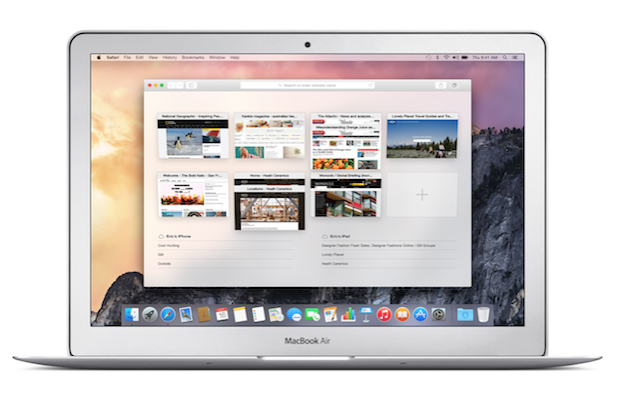
You and your UI
Yosemite has a new transparent view, but you may get slightly better system performance if you turn it off: System Preferences>Accessiblity>Display…"Reduce Transparency".
You can also set your menu bar and dock up to be darker, which you may prefer to Apple's default translucency. To use dark mode go to System Preferences>General…"Use dark menu bar and Dock".
Google may want one software platform to rule them all.
A top Google executive in charge of engineering for the company's Android mobile operating system is now also overseeing engineering for Chrome, software primarily used for personal computers, according to a person familiar with the situation.
 Hiroshi Lockheimer, Google's vice president of Android engineering, has taken on the duties of Linus Upson, his counterpart in the Chrome division. Upson has left the role, according to The Wall Street Journal, which earlier reported the news. While Lockheimer takes over engineering for Chrome OS, he won't be responsible for other Chrome-related products, including the Chrome Web browser, Chromecast TV streaming stick or Chromebook laptop hardware, according to the Journal.
A Google spokeswoman declined to comment.
Tech-savvy Indians have emerged as the most hooked on to gadgets globally with as many as 95 percent finding their smartphones “critically important” while 75 percent use their smartphone or tablet to book a hotel, says a survey by leading online travel firm Expedia.”The findings clearly suggest an increasing dependency on the mobile platform. 95 percent Indian respondents feel that their smartphone is very or of critical importance to their daily life,” Vikram Malhi, MD, Asia, Expedia said.
 He further said that Indians lead in app booking and data roaming plans globally.
“In fact, 75 percent of Indians who have used their smartphone or tablet to book a hotel have booked a hotel stay using a mobile app (the highest of any country), he said.
The survey highlights the maturation of Indian traveller who is fast moving up the ladder of travel apps and is no longer hooked with conventional modes of bookings, the findings said.
Micro blogging site Twitter is likely to announce a number of tools at a conference on Wednesday to make it easier for programmers to build apps, according to media reports.
 Developers were irked a couple of years back about the strict rules in existence with regard to applications, which plug into the social media service. The current move is seen as a damage control measure from Twitter.
"It is about relationship-building. If you start by offering services that are globally interesting to mobile developers and not just ones that are interested in traditional Twitter data, you can build a better relationship with more developers and introduce more of them to Twitter by delivering them value right away," Ryan Sarver, Twitter's former director of platform was quoted as saying in The Wall Street Journal.
 Tech giant Microsoft is reportedly set to release a smart watch of its own within weeks, joining Apple, Samsung and others in the smart watch race.
According to PC World, the smartwatch will passively track a wearer's heart rate and work across different mobile platforms, and that it would be able to go two days when fully charged. That would be an improvement over many current smartwatches, which often need to be charged nightly.
179 dollars, off-contract, this is the price of the Moto G second generation, a phone that took all the credits for Motorola’s success in 2014. And no, it’s not a high-end device, but it has a beautiful design, it works like a charm and doesn’t come with a mediocre camera.
Design
If you were expecting a big visual improvement to the new Moto G, well, we’re sorry to be a killjoy, but we don’t have much to say about the new additions. The Moto G 2014 isn’t very


